Pond Liner in Pakistan: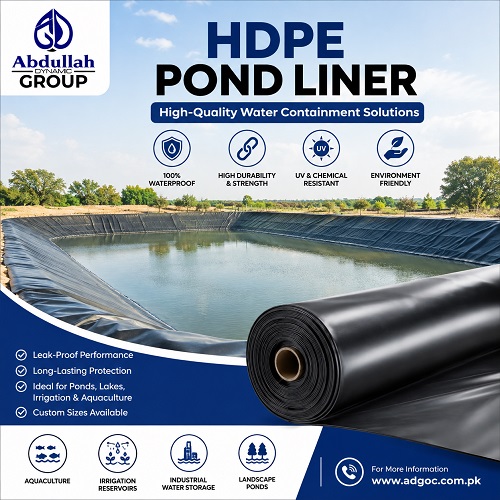
High-Quality Water Containment Solutions
Water conservation has become one of the most important challenges for Pakistan’s agricultural, industrial, and environmental sectors. From irrigation reservoirs and fish farming ponds to industrial wastewater containment and landfill engineering, selecting the right pond liner directly affects water retention, operating costs, and long-term performance.
HDPE (High-Density Polyethylene) pond liners are internationally recognized as one of the most reliable geomembrane solutions for preventing water seepage and protecting soil and groundwater. Their exceptional resistance to ultraviolet (UV) radiation, chemicals, punctures, and extreme temperatures makes them particularly suitable for Pakistan’s harsh climate, where prolonged exposure to sunlight and high summer temperatures can significantly reduce the lifespan of conventional lining materials.
Whether you are developing a farm water reservoir in Punjab, constructing a commercial fish farm in Sindh, building a rainwater harvesting system in Balochistan, or installing an industrial containment facility, choosing a premium-quality HDPE pond liner provides dependable long-term water containment with minimal maintenance requirements.
Our pond lining solutions are available in multiple thicknesses and roll sizes to suit projects ranging from small agricultural ponds to large-scale industrial reservoirs. Every installation is supported with technical guidance to help clients select the appropriate liner specification according to soil conditions, application requirements, and expected service life.
 Which pond liner is best for agriculture in Pakistan?
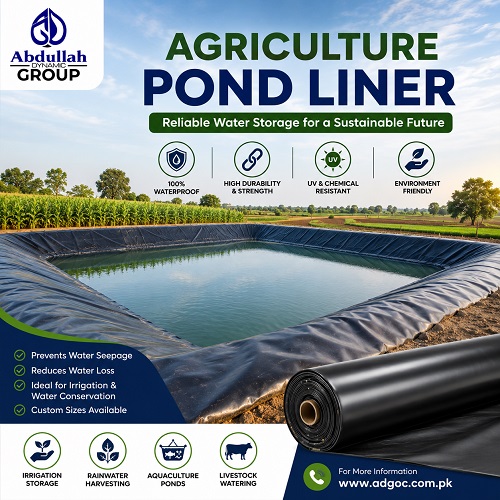
High-Density Polyethylene (HDPE) pond liners are widely regarded as the best choice for agricultural water storage in Pakistan due to their outstanding durability and low permeability. They provide excellent resistance to intense UV exposure, extreme summer temperatures, and long-term weathering, making them ideal for irrigation reservoirs and farm ponds. Properly installed HDPE liners help minimize water loss, reduce maintenance, and deliver reliable performance for many years.
Key Benefits
- Exceptional UV resistance for Pakistan’s harsh climate
- Excellent heat tolerance for prolonged outdoor exposure
- Superior leak prevention through very low permeability
- Long service life with minimal maintenance requirements
What is the cost of a pond liner in Pakistan?
The cost of a pond liner in Pakistan depends primarily on the selected liner thickness, the total installation area, and the overall project requirements. Prices may also fluctuate due to changes in international HDPE resin costs and USD-to-PKR exchange rates, making large projects subject to periodic market adjustments.
Request a Custom Quote Today
Planning a new water reservoir, fish farm, irrigation pond, or industrial containment system?
Our technical team can recommend the appropriate HDPE pond liner thickness based on your project size, soil conditions, expected lifespan, and budget. Contact us today for a customized quotation, material recommendations, and installation guidance.
Pond Liner Price in Pakistan
The following table provides indicative market pricing for HDPE pond liners commonly used in Pakistan. Actual prices vary depending on project size, quantity, roll dimensions, resin grade, installation requirements, and prevailing market conditions.
| Thickness (mm) | Primary Use Case | Lifespan / Durability | Estimated Price Scale* |
| 0.50 mm | Small irrigation ponds, landscaping, temporary reservoirs | Moderate (8–12 years) | PKR 250–450 per m² |
| 0.75 mm | Medium agricultural ponds, fish farming | High (10–15 years) | PKR 350–650 per m² |
| 1.00 mm | Commercial irrigation reservoirs, aquaculture | Very High (15–20 years) | PKR 500–850 per m² |
| 1.50 mm | Industrial containment, large reservoirs, landfill applications | Excellent (20–30+ years) | PKR 800–1,350 per m² |
| 2.00 mm | Heavy-duty chemical containment, mining, hazardous waste facilities | Maximum Durability (30+ years) | PKR 1,150–1,850 per m² |
Estimated prices are regional industry benchmarks and may vary depending on material grade, project complexity, exchange rates, freight charges, and installation requirements.
Large-volume projects often benefit from more competitive pricing because transportation, welding, and installation costs are distributed over a greater surface area. Custom roll widths and factory-fabricated panels can also reduce field welding time, improving installation efficiency and lowering the total project cost.
Why HDPE Pond Liners Are Preferred in Pakistan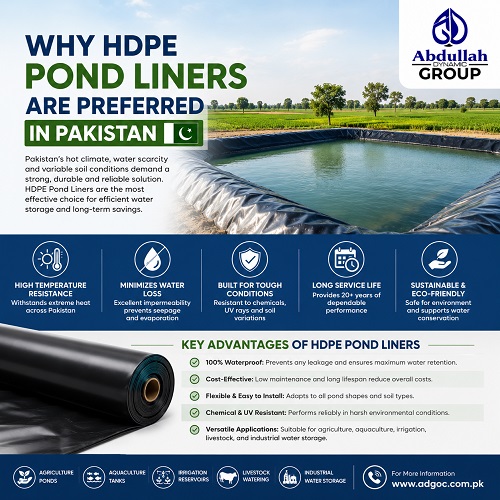

Pakistan experiences a wide range of environmental conditions, including extreme heat, prolonged UV exposure, seasonal flooding, saline soils, and fluctuating groundwater levels. These challenges require a lining material capable of maintaining its structural integrity over many years without significant degradation.
HDPE pond liners have become the preferred choice for government departments, agricultural enterprises, industrial facilities, engineering consultants, and private developers because they combine excellent mechanical strength with superior chemical resistance.
Unlike conventional clay linings or concrete structures, HDPE liners significantly reduce seepage losses while requiring minimal maintenance after installation. Their flexibility allows them to conform to irregular ground surfaces, and professionally welded seams create a continuous waterproof barrier that prevents leakage.
Key Advantages of HDPE Pond Liners
- Outstanding resistance to ultraviolet radiation
- Performs reliably in temperatures exceeding 50°C
- Excellent tensile strength for demanding engineering projects
- Superior puncture resistance compared to many conventional lining materials
- Resistant to fertilizers, agricultural chemicals, and many industrial substances
- Low water permeability for efficient water conservation
- Flexible enough to accommodate minor ground movement
- Long operational lifespan with reduced maintenance costs
- Suitable for permanent and temporary containment systems
- Available in multiple thicknesses to suit diverse project requirements
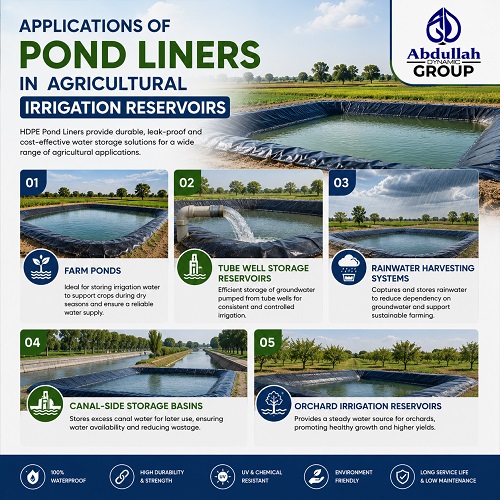
 Applications of Pond Liners in Pakistan
HDPE pond liners are widely used across multiple sectors where reliable water or liquid containment is essential.
Agricultural Irrigation Reservoirs
Agriculture remains one of Pakistan’s largest water consumers. Properly lined irrigation reservoirs help farmers reduce seepage losses, improve water availability during dry periods, and increase irrigation efficiency.
Typical applications include:
- Farm ponds
- Tube well storage reservoirs
- Rainwater harvesting systems
- Canal-side storage basins
- Orchard irrigation reservoirs
Fish Farming & Aquaculture
Commercial aquaculture requires stable water levels and controlled pond environments. HDPE pond liners help prevent water leakage while reducing contamination from surrounding soil.
Common applications include:
- Tilapia farms
- Carp farming
- Shrimp cultivation
- Hatcheries
- Aquaculture breeding ponds
The smooth surface also simplifies pond cleaning and supports better biosecurity management.
Industrial Water Storage
Many manufacturing industries require secure storage of process water and wastewater.
Applications include:
- Industrial reservoirs
- Firewater storage ponds
- Cooling water ponds
- Effluent treatment facilities
- Process water containment
Mining and Mineral Processing
Mining operations require robust containment systems capable of handling abrasive environments and challenging ground conditions.
HDPE liners are commonly installed in:
- Heap leach pads
- Tailings ponds
- Process water lagoons
- Mine water reservoirs
Their chemical resistance makes them suitable for demanding industrial environments.
Environmental Protection Projects
Government agencies and environmental consultants increasingly rely on HDPE geomembranes to protect groundwater and prevent contamination.
Applications include:
- Wastewater lagoons
- Environmental remediation
- Contaminated water storage
- Stormwater retention ponds
- Environmental containment systems
Get Free Technical Assistance
Selecting the correct pond liner involves more than choosing a thickness. Factors such as soil type, slope stability, water depth, exposure conditions, and intended application all influence long-term performance.
Our technical specialists can help you determine:
- Appropriate HDPE liner thickness
- Required ground preparation
- Protective geotextile requirements
- Welding and installation recommendations
- Estimated material quantities
- Transportation and logistics planning
Speak with our team today for expert technical guidance tailored to your project.
Why Professional Installation Matters
Even the highest-quality HDPE liner can underperform if installation is not carried out correctly. Proper site preparation, subgrade compaction, wrinkle management, seam welding, and quality testing are essential to ensure long-term waterproof performance.
Professional installation minimizes the risk of punctures, seam failures, and premature material damage while maximizing the service life of the pond lining system.
For critical applications such as industrial containment, municipal reservoirs, and large agricultural ponds, experienced installation teams use specialized hot wedge and extrusion welding equipment to create strong, continuous seams that comply with international geomembrane installation practices.
Continued in Part 2: Regional soil recommendations for Punjab, Sindh, Balochistan & KPK, technical specifications, material properties, industrial applications, installation methodology, and additional conversion-focused content.